
Licensed General Contractor · Licensed New Home Builder in MD · 20+ Years DC, Maryland & Virginia Construction Experience
Thinking about building a custom home in the DC, Maryland, or Northern Virginia suburbs?
Before you buy a teardown lot, tear down an old house, or start designing your dream home, you need to understand one thing first:
The listing tells you what the property looks like. Zoning tells you what the property actually allows.
And those two things are not always friends.
A lot may look perfect online — great location, nice street, mature trees, and "value in the land" — but setbacks, lot coverage, FAR, height limits, easements, stormwater rules, and local zoning regulations can quickly change what is actually possible.
In other words: your Pinterest board does not decide what you can build. Zoning does.
What Are Zoning Regulations?
Zoning regulations are local rules that control how land can be used and what can be built on a property.
In the DMV area — Washington, DC, Maryland, and Northern Virginia — zoning can affect:
- Whether you can build a new home
- How large the home can be
- How tall the home can be
- How close the house can sit to property lines
- How much of the lot can be covered by structures
- Whether you can build an addition, garage, pool, deck, or ADU
- Whether stormwater, utilities, trees, or easements create extra restrictions
Basically, zoning is the referee. And unlike your kids' soccer referee, zoning does not care that you already bought the lot.
Why DMV Homeowners Need to Pay Attention
The DMV is not one simple rulebook.
- A lot in Bethesda may follow Montgomery County zoning rules.
- A lot in McLean may follow Fairfax County rules.
- A lot in Arlington may have different lot coverage and setback requirements.
- A DC rowhouse lot may deal with lot occupancy, height limits, rear yards, historic review, and more.
- A Prince George's County property may have a completely different set of rules depending on the zoning classification and local municipality.
Translation: the same house design may work in one jurisdiction and completely fail in another.
That is why "Can I build on this lot?" is not a vibes-based question. It is a zoning question. A survey question. A civil engineering question. And occasionally, a "why is there a mysterious easement running through my future pool?" question.
The Big Zoning Rules That Matter Most
1. Zoning Classification
Your zoning classification tells you what type of property you have and what rules apply.
In the DMV, residential zoning can affect minimum lot size, building height, setbacks, lot coverage, density, accessory structures, and whether certain uses are allowed.
Do not assume that because there is already a house on the lot, you can automatically build the house you want next. The old house may be grandfathered in. Your new house may not be invited to that grandfather party.
2. Setbacks
Setbacks are the required distances between your house and the property lines. These usually include:
- Front setback
- Rear setback
- Side setback
- Side street setback if you are on a corner lot
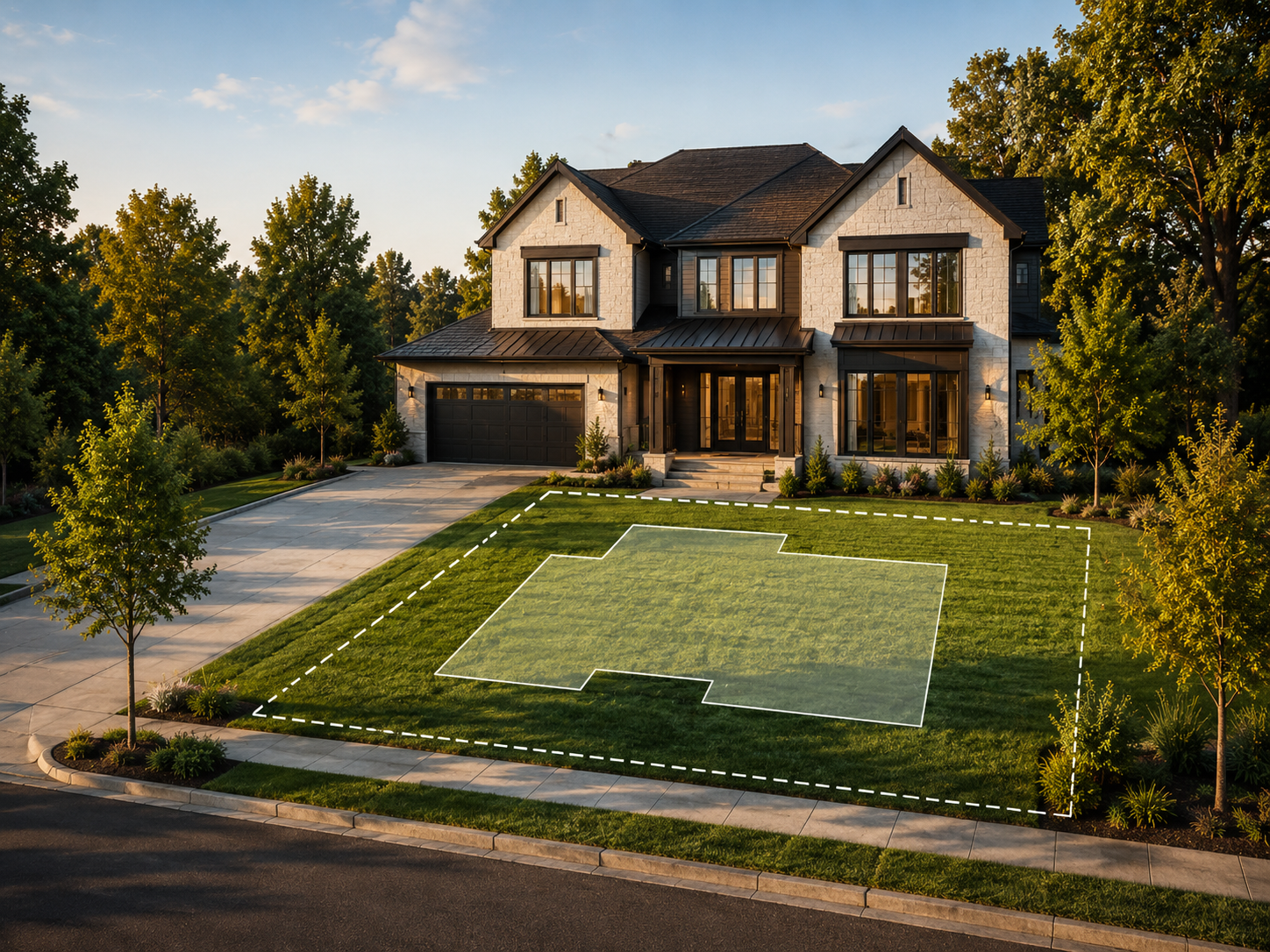
This is where homeowners often get surprised. A lot can look huge on paper, but once setbacks are applied, the actual buildable area may shrink fast. Very fast.
The key idea is simple:
- Lot width minus side setbacks = possible building width.
- Lot depth minus front and rear setbacks = possible building depth.
What is left is your buildable envelope. That envelope determines where the house can actually sit. Not where you wish it could sit. Where it can legally sit. For a deeper dive, see Setback Requirements Explained.
3. Lot Coverage
Lot coverage controls how much of your property can be covered by structures. This may include the main house footprint, garage, porch, covered patio, accessory structures, and other improvements depending on the jurisdiction.
This matters because you cannot always solve your square footage problem by spreading the house wider. Sometimes zoning says: "Cute idea. No."
4. FAR, or Floor Area Ratio
FAR limits how much floor area you can build compared to the size of the lot. This is especially important for custom homes and teardown projects in dense DMV neighborhoods.
If FAR limits your above-grade square footage, the basement may become part of the design strategy. That is one reason many new homes in Bethesda, Chevy Chase, Arlington, and DC suburbs include finished lower levels.
It is not just because everyone suddenly needs a gym, guest suite, wine room, playroom, golf simulator, and "flex space." It is often zoning math. For more, see How Big of a House Can I Build on My Lot?
5. Impervious Surface
Impervious surface includes areas that do not absorb water, such as:
- House footprint
- Driveways
- Patios
- Walkways
- Pool decks
- Some hardscape areas
This is the rule that quietly ruins outdoor living dreams. You may fit the house. You may fit the driveway. Then you add a patio, pool, and walkway — and suddenly your lot is saying, "I'm full."
In the DMV, stormwater management is a real issue. Pushing impervious surface limits can trigger extra engineering, drainage design, approvals, and cost.
6. Height Limits
Height limits control how tall your home can be. This matters when homeowners want to build up instead of out. In some neighborhoods, going vertical may be the best way to get more square footage while staying within setbacks and lot coverage rules.
But height is not always measured the way homeowners expect. Local codes may define building height differently, and sloped lots can make the calculation more complicated. Because apparently, even gravity has paperwork.
The DMV Zoning Mistake Homeowners Make Most
The biggest mistake homeowners make is designing the house before analyzing the lot. That is backwards. The lot tells you what the house can be.
Before you spend money on architectural plans, you should check:
- Zoning classification
- Lot dimensions
- Front, rear, and side setbacks
- Lot coverage limits
- FAR, if applicable
- Height restrictions
- Flood zone status
- Easements
- Tree restrictions
- Utility access
- Stormwater requirements
- Existing survey and plat conditions
A beautiful design that does not fit zoning is not a home plan. It is an expensive piece of art.
This is especially important in the DMV because every jurisdiction has its own rules. A lot in Bethesda, Arlington, McLean, Washington, DC, or Prince George's County may all come with different zoning requirements, review processes, and hidden constraints.
That is why the first question should not be: "Can we design the house we want?" The first question should be: "What will this lot actually allow?"
Who Should Homeowners Contact to Understand What They Can Build?
Most homeowners assume the first person to call is an architect. That makes sense. Architects design houses. They make floor plans work. They help turn ideas into something beautiful, functional, and permit-ready.
But when the question is: "What can I actually build on this lot?" — the first professional you usually want involved is a civil engineer or site engineer.
Why? Because before anyone designs the dream home, someone needs to understand the dirt, the setbacks, the utilities, the grading, the stormwater requirements, the driveway access, the easements, and the buildable envelope.
In other words: the architect designs the house. The civil engineer helps determine what the lot can realistically support.
A civil engineer can help evaluate:
- Zoning constraints
- Building setbacks
- Lot coverage limits
- Impervious surface limits
- Utility access
- Sewer and water connections
- Grading and drainage
- Stormwater management
- Easements
- Driveway location
- Site plan feasibility
An architect may be able to spot obvious issues, but a civil engineer is usually the professional who digs into the site-specific restrictions that can make or break a project.
Think of it this way:
- An architect helps answer: "What should the house look like?"
- A civil engineer helps answer: "Can this lot actually handle that house?"
And in the DMV, that second question should come first. Because nobody wants to spend money designing a beautiful custom home only to find out later that the driveway grading does not work, the stormwater plan is a nightmare, the utilities need major upgrades, or the house does not fit inside the buildable envelope.
Before you fall in love with a floor plan, get the lot checked first.
Quick Homeowner Checklist: What to Check Before You Build
Before buying a lot, tearing down an old home, or planning a major renovation in the DMV, ask:
- What is the zoning classification?
- What are the front, rear, and side setbacks?
- What is the maximum lot coverage?
- Is there a FAR limit?
- What is the height limit?
- Are there easements on the property?
- Is the property in a floodplain, stream buffer, or historic district?
- Are there tree preservation rules?
- Can utilities support the home you want?
- Has someone calculated the buildable envelope?
- Has a civil engineer reviewed the site?
- Does the design work with stormwater, grading, and driveway access?
If the answer to number 10 is "not yet," do not panic. But also do not call the architect and ask for a 7,000-square-foot modern farmhouse just yet. The smarter move is to check the lot first, then design around what is actually possible.
Download the Free DMV Zoning Pre-Check Checklist
Before you buy, design, or demo, use this checklist to review zoning classification, setbacks, lot coverage, FAR, height limits, buildable envelope issues, and when to involve a civil engineer.
This checklist is a homeowner-friendly starting point and is not a substitute for a site-specific zoning review. Zoning rules vary by jurisdiction, property, overlay zone, lot shape, and existing conditions. Before purchasing, designing, or permitting a project, confirm requirements with the local zoning office and consult a civil engineer or site engineer.
Why This Matters Before You Buy
Zoning regulations can affect more than the size of the house. They can affect:
- Purchase price
- Design options
- Permit timeline
- Site engineering costs
- Construction budget
- Resale value
- Whether the project still makes financial sense
A lot that looks like a great deal may be less attractive once you account for setbacks, lot coverage, FAR, stormwater, utilities, and civil engineering constraints.
That is why zoning should be reviewed before you buy, not after closing. After closing, surprises are no longer due diligence. They are just bills.
Use LotIQ Before You Buy or Design
Before you spend money on a lot, architectural plans, or a full design package, start with the site.
LotIQ helps homeowners, buyers, and owner-builders quickly evaluate key lot issues like zoning, setbacks, buildability, flood risk, soil conditions, and potential home size.
It is not a replacement for a full civil engineering review, but it is a smart first step. Think of it as the "should I even keep going?" check before you fall in love with the wrong lot. Because the only thing worse than finding out a lot has problems is finding out after you already bought it.
Related Reading
Final Thought: Zoning Is Boring Until It Gets Expensive
Zoning regulations are not fun dinner conversation. But neither is telling your spouse: "Bad news — the dream house does not fit on the lot we already bought."
For homeowners in the DMV, zoning is one of the first things to check before buying land, tearing down a house, or starting a major renovation.
The smartest move is simple: analyze the lot before you fall in love with the plan.
At Iron Gate Development, we help homeowners, owner-builders, and investors understand what can realistically be built before they spend money in the wrong direction.
Thinking about a lot in DC, Maryland, or Northern Virginia? Start with the numbers. Then build the dream.
Thinking about building on a lot in DC, Maryland, or Northern Virginia?
Before you hire an architect or fall in love with a floor plan, start with the lot. Use LotIQ to check zoning, setbacks, buildability, and hidden constraints, then read our full guide: Can I Build on This Lot? How to Check Before You Buy.
This article is provided for informational purposes only and does not constitute legal, engineering, or construction advice. Zoning regulations, setback requirements, lot coverage limits, FAR, height rules, and stormwater requirements vary by jurisdiction, overlay zone, lot shape, and existing site conditions, and change over time. Always confirm current requirements with the local zoning office and consult a licensed civil engineer, surveyor, architect, and/or attorney before purchasing, designing, or permitting a project.
Vipin Motwani
Founder, Iron Gate Development